



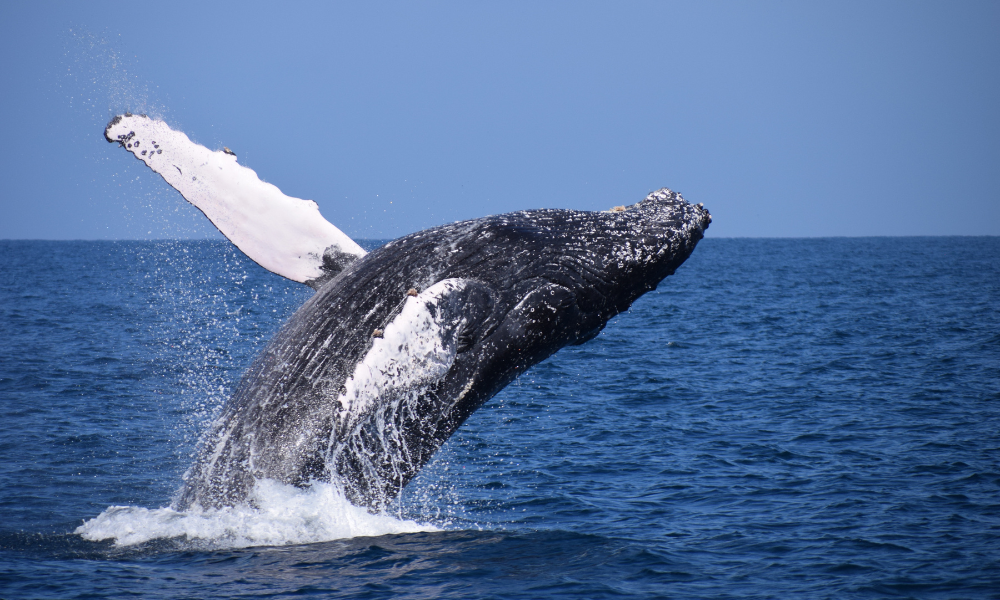
The list of reasons to visit the Whitsundays is an extensive one, filled with natural wonders that nowhere else in the world has to offer.
Lush, ancient rainforests, spectacular reefs full of marine life, tropical islands with the whitest sand you’ll ever see, and each year during the cooler months, the annual humpback whale migration.
When Is Whale Season in the Whitsundays?
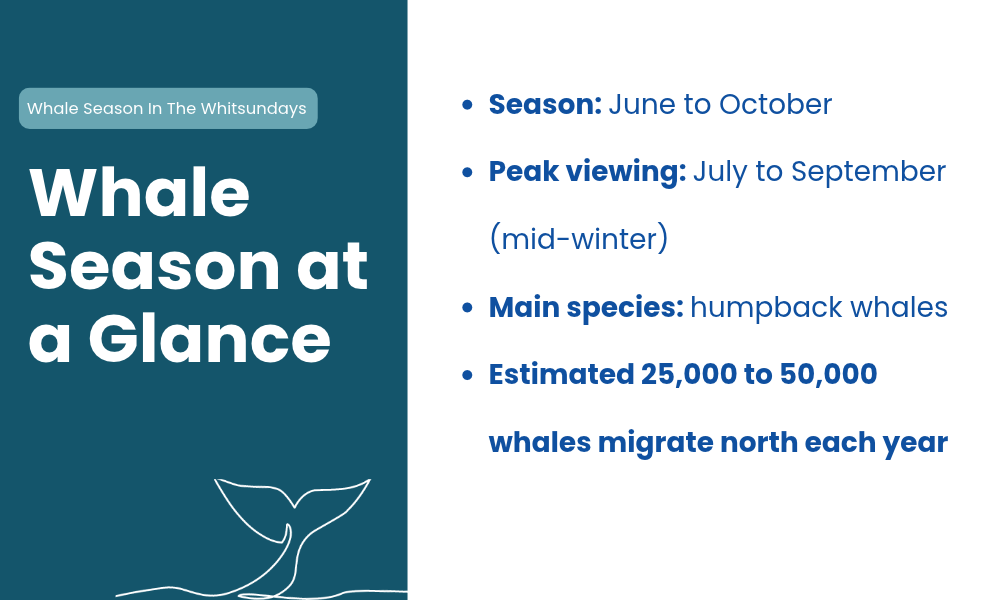
The whale season in the Whitsundays goes from June to October, with the peak season being the mid-winter months.
The Whitsundays is home to more than 1,500 species of fish, over 400 types of coral, and numerous other animals such as sea turtles, sharks, and rays.
Most are present throughout the year, and visitors can swim, snorkel or scuba dive and be amazed by the wonder of the seemingly countless critters the underwater world has to offer.
But the whales are migratory, and from May to August they leave the cold, krill-rich waters of Antarctica and head north, passing Tasmania, travelling along the New South Wales Coast and ending up in the warm waters of the Great Barrier Reef.
Where do the Whales Migrate From?
The humpback whales that find their way to the Whitsundays are travelling thousands of kilometres from the cold feeding waters of the Antarctic to the warm, breeding waters of northern Australia.
It’s estimated that somewhere between 25,000 and 50,000 whales leave the polar south, making their way northward, passing alongside Victoria, skirting Sydney and Byron Bay before eventually finding their way to the safer waters of the Whitsundays and tropical Queensland.
The southern waters of Antarctica are abundant with krill, the main food of the whales. They feed constantly, building up fat reserves that fuel their northward journey.
The warmer, tropical seas provide them with calmer conditions for breeding and calving, with lower risk of predation from killer whales.
The first arrivals in the tropics are the younger males, followed by pregnant females and breeding adults. The safety of the warm waters provides a place to birth and nurse their young, mate and recover before returning to the south.
What Types of Whales Can You See in the Whitsundays?
Four species of dolphin and six species of whale have officially been recorded in the Whitsundays.
While species like short-finned pilot whales can be encountered year-round, and there’s also the chance of spotting a migrating dwarf minke whale in the winter months, the most commonly sighted species of whales on the Whitsundays are humpback whales.
The Whitsundays act as a nursery and resting ground for them and they typically spend more time in the region than other whale species. What’s more, their sheer size and behaviours like tale slapping and breaching, make them easy to spot.
Where Are the Best Places to See Whales in the Whitsundays?
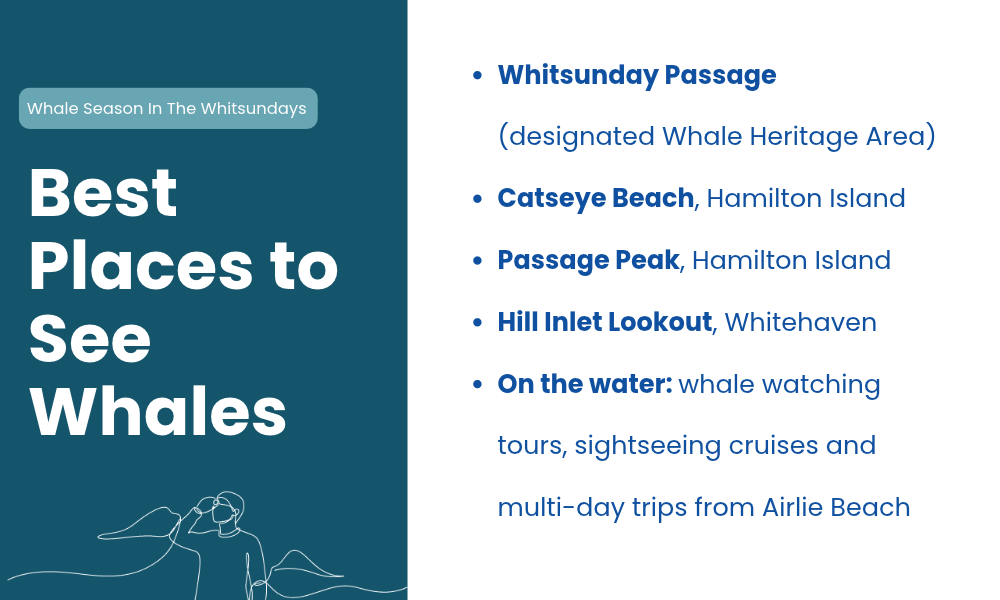
The best places to see whales in the Whitsundays are in the protected waters and calm bays that surround the islands, and in the marine channels they use for transiting between locations.
The Whitsunday Passage and 74 Islands of the region is a designated Whale Heritage Area, as the protected waters between the islands serve as a primary calving ground. This means it’s possible to encounter a whale almost anywhere in the area.
However, some of the best locations for viewing are Catseye Beach and Passage Peak on Hamilton Island, as well as Hill Inlet lookout on Whitehaven.
Arguably the best way to see humpback whales in the Whitsundays is aboard either a specific whale watching tour or even a general sightseeing/multi-day trip out of Airlie Beach.
By boarding a vessel and heading out to the islands, you’ll be passing through waters thick with migrating humpbacks. Typically, the captain and crew will have their eyes on the horizon, spotting whales as the breach, blow from their spouts and tale slap.
As you sail or cruise between the islands you will be amazed by the site of these magnificent animals as they seemingly play up for the spectators.
How Can You Get the Most Out of Whale Watching in the Whitsundays?
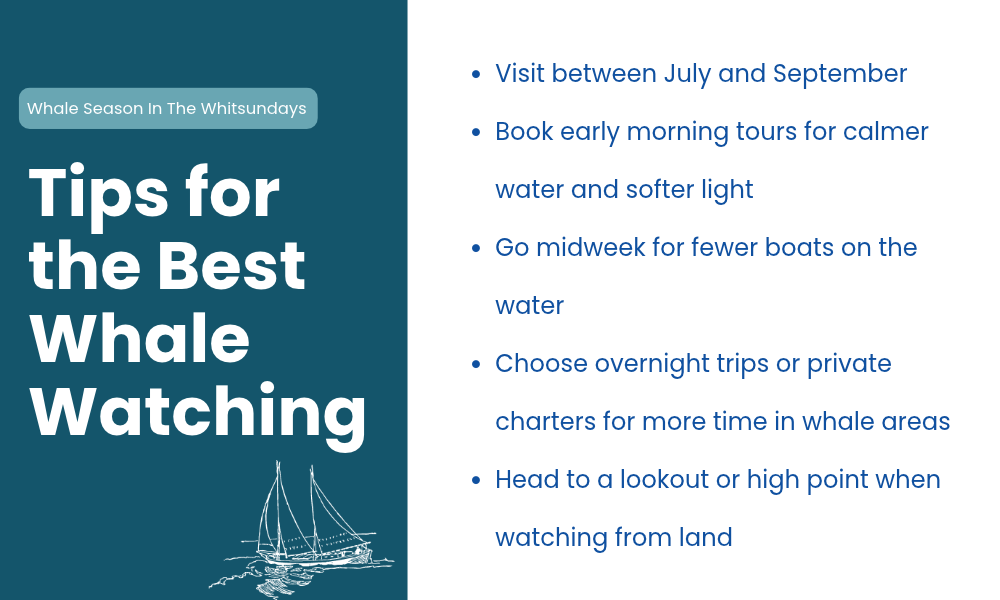
To get the most out of whale watching in the Whitsundays, start by planning your visit around the best months, from July to September.
Also on the timing front, if you’re booking a tour or cruise, opt for an early morning one when the water is generally calmer, the light less harsh and there are fewer boats moving around. Heavy traffic can deter the whales from spending more time on the surface.
To help with less boating activity, midweek is ideal as there are fewer fishermen and holidaymakers about.
A lot of the Whitsundays region is a designated Whale Protection Area where commercial whale-watching vessels face strict distance rules. This means seeing whales usually happens by chance while cruising.
However, if you book an overnight boat tour or a private charter, you’ll have greater flexibility to spend more time on the water in areas where there’s more whale activity.
If you’re limited to land-based viewing, the great thing about the Whitsundays is that there are plenty of lookouts and high points that provide great views across the sea.
Passage Peak on Hamilton Island and Hill Inlet Lookout on Whitehaven are two of the best vantage points you can find for whale spotting. There are also plenty of places where whales can be spotted from the shore, particularly if you’re on one of the outer islands.
Rules and Etiquette for Whale Spotting
There are strict rules for whale watching, designed to help protect them and minimise human impact.
Vessels must stay at least 300 meters away from whales and 150 meters away from calves, and there’s no swimming allowed within 100 meters.
As a rule, it’s best to allow the whales to approach your boat rather than chasing them.